Pattern Matching (Съпоставяне на образци)
Какво е Pattern Matching?
- Мощен инструмент, използван основно в функционалните езици за програмиране
- Проверява някаква стойност спрямо някакъв шаблон/образец
- Използва се за декомпозиция на данни от по-сложни структури
- Прилича на
switch/caseизрази, но е много по-гъвкав и мощен
Синтаксис
def getDayOfWeek(day: Int): String = day match
  case 1 => "Monday"
  case 2 => "Tuesday"
  case 3 => "Wednesday"
  case 4 => "Thursday"
  case 5 => "Friday"
  case 6 => "Saturday"
  case 7 => "Sunday"
  case _ => "Invalid day!"
<target> match
case <pattern1> => <result1>
case <pattern2> => <result2>
...
[case _ => <defaultResult>]- ключови думи
matchиcase - ако target съвпада с някой от образците, се изпълнява съответният резултат
- може да има “wildcard” образец
_, който съвпада с всичко и служи като default case
Видове прости образци - съпоставяне по константи
Видове прости образци - съпоставяне по типове
enum Color:
  case Red, Green, Blue, Yellow, Orange, Purple

case class ShipmentId(value: String) extends AnyVal

case class User(name: String, age: Int)

def describe(x: Any): String = x match
  case i: Int => s"An integer: $i"
  case s: String => s"A string: $s"
  case l: List[_] => s"A list of size ${l.size}"
  case c: Color => s"A color: $c"
  case s: ShipmentId => s"A shipment ID: ${s.value}"
  case u: User => s"A user: ${u.name}, age ${u.age}"
  case _: Double => "A random double"
case _ => "Unknown type"- Можем да даваме имена на променливи в образците и да ги използваме в резултата
- Можем и само да посочваме типа, без да даваме име на променлива
Съставни образци - деструктуриране на наредени n-торки (tuples)
(pattern1, pattern2, ..., patternN)
Съставни образци - деструктуриране на case класове
Person(pattern1, pattern2, pattern3)
case class Person(name: String, age: Int, city: String)

val CanNowDrinkAlcohol = 18

def describePerson(p: Person): String = p match
  case Person("Pesho", 24, "Varna") => "Pesho from Varna"
  case Person(name, CanNowDrinkAlcohol, _) => s"$name can now drink alcohol"
case Person(name, _, city) => s"$name lives in $city"Съставни образци - списъци
head :: tail- съставен образец за списък, който се състои от глава и опашка
def describeList[A](list: List[A]): String = list match
  case Nil => "An empty list"
  case head :: Nil => s"A single element list: $head"
case head :: tail => s"A list with head: $head and tail of size ${tail.size}"- Тук можем ли да заменим нещо с wildcard образец
_?
Съставни образци - колекции
Seq(first, second, third)Seq(first, second, rest*)
def describeSeq[A](seq: Seq[A]): String = seq match
  case Seq() => "An empty sequence"
  case Seq(first) => s"A single element sequence: $first"
  case Seq(first, second) => s"A two element sequence: $first and $second"
  case Seq(first, second, rest*) => s"A sequence with first: $first, " +
        s"second: $second and rest of size ${rest.size}"
Съставни образци - наследяване на класове
Комбинация от име и съставен образец
sealed trait Shape
case class Circle(radius: Double) extends Shape
case class Rectangle(width: Double, height: Double) extends Shape

def describeShape(shape: Shape): String = shape match
  case c @ Circle(r) => s"A circle $c with radius $r"
case r @ Rectangle(w, h) => s"A rectangle $r with width $w, height $h"- Оператор
@ни позволява да даваме име на цялата съвпаднала стойност, докато същевременно я декомпозираме с образец
Съпоставяне на алтернативи
pattern1 | pattern2 | pattern3
enum Color:
  case Red, Green, Blue, Yellow, Orange, Purple

def isPrimaryColor(color: Color): Boolean = color match
  case Color.Red | Color.Green | Color.Blue => true
case _ => false- Оператор
|ни позволява да съпоставяме няколко алтернативни образeца в единcase - Тези няма да работят:
case Some(x) | None => ...case Some(x) | Some(y) => ...case (x, y, z) | (x, y) => ...case a: String | b: Int => ...case Circle(r) | Rectangle(w, h) => ...
- Алтернативните образци трябва да въвеждат едни и същи променливи — със същите имена и в същата структура
Съпоставяне на алтернативи - вложени образци
If guards при съпоставяне на образци
pattern if condition
Какво ще стане, ако не съпоставим всички възможни случаи?
def getDayOfWeek(day: Int): String = day match
  case 1 => "Monday"
  case 2 => "Tuesday"
  case 3 => "Wednesday"
  case 4 => "Thursday"
case 5 => "Friday"- Ще гръмнем по време на изпълнение с
MatchError, ако подадем стойност, която не съвпада с нито един от образците - Компилаторът няма да ни предупреди, че не сме съпоставили всички
- Intellij Idea се справя добре и ни предупреждава за непълно съпоставяне при sealed trait йерархии и enum-и
Какво ще стане, ако няколко образеца съвпадат?
- Ще се изпълни първият съвпаднал образец, който компилаторът срещне
- Intellij Idea се справя добре и ни предупреждава за образци, които са “затрупани” от по-общи образци, които ги предхождат
- Важно е да подреждаме образците от най-специфичните към най-общите
Приложения - при конструкции match
- Всички примери, които видяхме досега
Приложения - при изрази, очакващи функции
Function1,Function2,PartialFunctionи други функционални типовеmap,filter,flatMap,collect,foldLeft,foldRightи други функции от по-висок ред, които приемат функции като аргументи
Приложения - при дефиниране на функции
sealed trait Command
case class Move(x: Int, y: Int) extends Command
case object Stop extends Command
case class Speak(message: String) extends Command

def executeCommand: Command => Unit =
  case Move(0, 0) => println("Staying in place")
  case Move(x, y) => println(s"Moving to ($x, $y)")
  case Stop => println("Stopping")
  case Speak(message) => println(s"Speaking: $message")
Приложения - при дефиниране на val
case class Person(name: String, age: Int, city: String)

val (first, second) = (1, "hello")
val person @ Person(name, age, city) = Person("Pesho", 24, "Varna")- Какво ще стане тук?
Приложения - при for comprehension
- В лявата част на for comprehension можем да използваме образци
val list1 = List(1, 2, 3, 4, 5)
val list2 = List(10, 20, 30, 40, 50)
val list3 = List(100, 200)

for
  (a, b) <- list1 zip list2
  c <- list3
yield a + b + c- Задължително е образът вляво да е такъв, за който компилаторът може да провери, че ще съвпадне
Приложения - при for comprehension
val people = List(("Zdravko", 35), ("Boyan", 4), ("Viktor", 30), ("Taylor", 35))

for
  case (name, 35) <- people
yield s"$name is 35"- Можем да използваме думата
caseпред образеца- Така ще се филтрират само елементите, които съвпадат с образеца
- Изисква се обектът, на чието ниво е for comprehension-а, да има
withFilterилиfilterметод, който да може да филтрира елементите спрямо образеца
Приложения - при try/catch блокове
try
  doSomethingRisky()
catch
  case e: NullPointerException => println("Caught a NullPointerException")
  case e @ (_: UnsupportedOperationException | _: IllegalArgumentException) =>
    println(s"Caught one of two special exceptions: ${e.getMessage}")
  case e: Exception => println(s"Caught a general exception: ${e.getMessage}")
case NonFatal(e) => println(s"Caught a non-fatal exception: ${e.getMessage}")NonFatalе образец, който съвпада с всички изключения, които не са фатални (катоVirtualMachineError,InterruptedException,OutOfMemoryError,StackOverflowErrorи други)
Екстрактори
- Обекти, които имат методи
unapplyилиunapplySeq - Позволяват деструктуриране на части на обекти от определен тип
Екстрактори - unapply метод
- Използва се при фиксиран брой елементи
class URL(protocol: String, domain: String)

object URL:
  def unapply(url: String): Option[(String, String)] =
    url.split("://", 2) match
      case Array(protocol, rest) => Some((protocol, rest))
      case _ => None

List(
  "https://example.com",
  "ftp://files.server.com",
  "invalid-url",
  "http://scala-lang.org"
)
.collect:
case URL(protocol, domain) => s"Protocol: $protocol, Domain: $domain"- Какъв ще е резултатът?
Екстрактори - unapplySeq метод
- Използва се при променлив брой елементи
class CsvRow(values: String*)

object CsvRow:
  def unapplySeq(row: String): Option[Seq[String]] =
    Some(row.split(",").toSeq)

List("John,Doe,30", "Jane,Smith,25", "InvalidRow", "Alice,Bob")
  .collect
    case CsvRow(first, second, rest*) => s"First: $first, " +
s"Second: $second, Rest: ${rest.mkString(";")}"По-подробно за pattern matching при List
Да упражним наученото 🏎️
Какво са ADTs?
- Начин за моделиране на данни чрез комбиниране на типове
- Основават се на математическата теория на множествата
- Позволяват ни да дефинираме точно какви стойности може да приема един тип
- Основен инструмент за постигане на “type safety” в Scala
- Документация: Типовете описват бизнес логиката по-добре от коментарите.
Видове ADTs
ADTs се изграждат чрез две основни концепции:
- Product Type (Тип “И”): Стойността съдържа тип А И
тип B (напр.
Case ClassилиTuple) - Sum Type (Тип “Или”): Стойността е или от тип А,
ИЛИ от тип B (напр.
sealed Traitилиenum) - Hybrid ADTs: Комбинация от горните две
Product Types
- Стойностите се комбинират заедно.
- Името идва от това, че броят на възможните стойности е декартово произведение от неговите компоненти.
Product type complexity
- (Byte, Boolean)
- Complexity: 256 * 2 = 512
- (Boolean, Unit)
- Complexity: 2 * 1 = 2
- (String, Nothing)
- Complexity: many * 0 = 0
Sum Types
- Типът може да бъде само една от изброените възможности и никоя друга.
- Името идва от това, че броят на възможните стойности е сума от всички подтипове
Sum type complexity
- Byte | Boolean
- Complexity: 256 + 2 = 258
- Boolean | Unit
- Complexity: 2 + 1 = 3
- Byte | Nothing
- Complexity: 256 + 0 = 256
Exponential types
- Complexity: 4
- Complexity: 8
Функциите имат експоненциална сложност
Защо експоненциална?
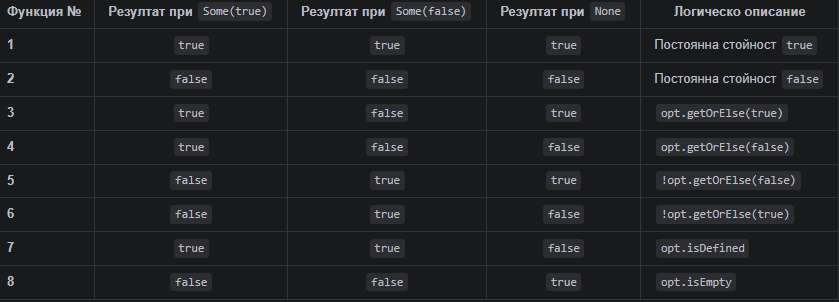
Таблица на възможните функции за f2(Option[Boolean]): Boolean
Математическа сложност: 23 = 8 възможни уникални имплементации.
Hybrid Types
- Мощен начин за моделиране на бизнес логика.
- Използваме enum или sealed trait, където отделните случаи могат да бъдат case class (Product types).
sealed trait Notification
case class Email(address: String, subject: String, body: String) extends Notification
case class SMS(phoneNumber: String, message: String) extends Notification
case class Push(deviceToken: String, title: String, priority: Int) extends Notification // "Сума" от различни "Произведения"Enum vs Sealed trait
Multi level ADTS
Type Inference and Type identity
enum Result:
  case Success(data: String)
  case Failure

// You cannot easily use 'Success' as a type here
// because it is a value of the type 'Result'.
def process(success: Result.Success) = println(success.data)

// The compiler infers 'Result', losing the 'Success' specific info
val x = Result.Success("Done")
// will not compile
x.data

// We have to specifically define the type
val y: Result.Success = Result.Success("Done")
// compiles
y.data
Make illegal states unrepresentable
Моделиране чрез SUM types
Друг пример
Smart constructors
case class MonthlyLimit private (value: Double)
object MonthlyLimit:
  def apply(value: Double): Option[MonthlyLimit] = value match
    case d if d <= 0d => None
    case d if d > 10000d => Some(new MonthlyLimit(10000d))
    case _ => Some(new MonthlyLimit(value))

sealed trait Card
  case class CreditCard(monthlyLimit: MonthlyLimit) extends Card
  case object DebitCard extends Card

val maybeCard: Option[Card] = for
  monthlyLimit <- MonthlyLimit(1000)
 yield CreditCard(monthlyLimit)
Ползи от този подход
- По-малко тестове: Не е нужно да тествате сценарии, които са невъзможни за достигане
- Без defensive programming
(
if x != nullилиif isInvalidпроверки) - По лесен за разбиране код (self documenting)
- По малко бъгове
- Безопасен рефакторинг: Ако променим структурата, компилаторът показва грешките:
ADTs
- Правят некоректните състояние невъзможно за репрезентиране
- Гарантират, че кодът ще покрие всички случаи
- Гарантират, че кодът ще покрие само възможните случаи
Generalised Algebraic Data Types
Типизирано ADT, при което някои product типовете са дефинирани само за специфични типове
Nicolas Rinaudo: Far more than you’ve ever wanted to know about ADTs